
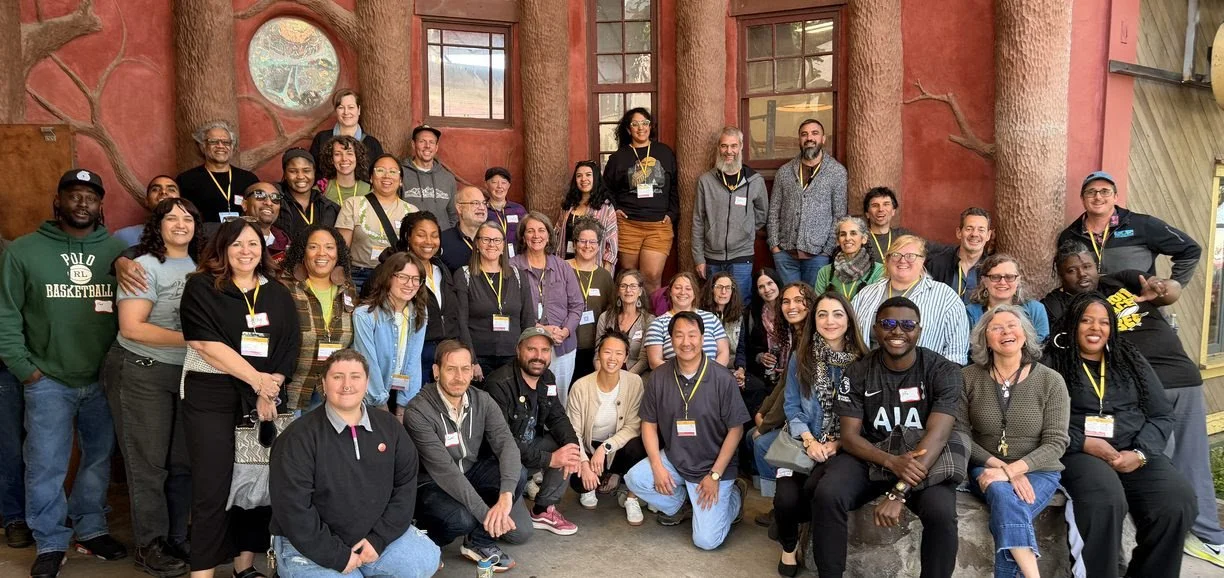
A few weeks ago, the ReBuilding Center hosted the Levine Impact Lab Cohort Retreat—a group of climate action leaders from 13 states working across reuse, recycling, circular economy initiatives, environmental stewardship, community resilience, and systems change. As part of the experience, we toured ReBuilding Center and used our operations as a living case study to explore the realities, tensions, and opportunities facing the reuse sector today.
Material sourcing.
Staffing.
Processing and logistics.
Balancing mission and revenue.
Public participation.
Education.
Disposal.
None of these challenges were particularly surprising.
What was surprising was how quickly participants recognized them.
At nearly every stop, someone would nod and say, “We're dealing with that too.”
Different organizations.
Different communities.
Different business models.
The same challenges.
And that led us to a bigger question:
At what point does a recurring organizational challenge stop being an organizational problem and start becoming an infrastructure problem?
For years, the reuse sector has approached many of its challenges as individual organizational issues.
A nonprofit needs more material donations.
A reuse store needs more storage space.
A deconstruction company needs more trained workers.
A repair program needs more funding.
A community organization needs more public participation.
Viewed individually, these appear to be isolated operational struggles.
But when organizations across the country are experiencing the same obstacles over and over again, it may be signaling something else entirely.
It may be signaling that the supporting infrastructure doesn't yet exist.
Consider waste management.
There was a time when trash collection was fragmented, inconsistent, and largely left to individuals to figure out on their own. Over time, communities invested in systems.
Collection routes.
Transfer stations.
Landfills.
Public education.
Regulations.
Funding mechanisms.
Shared expectations.
Today, most people don't think about waste infrastructure because it has become embedded into everyday life. Participation is normal. The systems exist. The responsibility is shared.
Now consider reuse.
In many communities, disposal remains easier than donation.
Replacement remains easier than repair.
New materials remain easier to access than reclaimed ones.
Organizations often find themselves independently building procurement systems, logistics networks, workforce pipelines, educational programs, impact measurement tools, and public awareness campaigns.
The result is tremendous innovation.
It is also tremendous duplication.
During the workshop, the conversation gradually shifted away from the challenges facing individual organizations and toward a larger question facing the field itself.
What would it look like if reuse, repair, and material recirculation were treated as essential community infrastructure?
What if every community had convenient pathways for material recovery?
What if repair skills were taught as routinely as recycling is promoted?
What if contractors, municipalities, schools, businesses, and residents all participated in systems designed to keep valuable materials in circulation?
What if success didn't depend on a handful of organizations solving the same problems independently?
These aren't just questions about waste.
They're questions about how communities steward finite resources.
Every year, ReBuilding Center sees thousands of doors, cabinets, windows, fixtures, and building materials arrive at our facility with useful life still left in them.
The challenge is rarely whether value exists.
The challenge is whether systems exist to recognize, recover, and recirculate that value before it is lost.
That realization stayed with me long after the workshop ended.
Across the country, organizations are experimenting, innovating, and solving problems in their own communities. Yet many of the barriers they face are remarkably similar. Staffing shortages. Logistics challenges. Public awareness gaps. Funding constraints. Fragmented systems. Competing incentives that often make disposal easier than reuse.
When the same challenges emerge repeatedly across regions and organizations, perhaps the conversation needs to evolve.
Perhaps the next chapter of the reuse movement is not simply helping individual organizations become stronger.
Perhaps it is building the infrastructure that makes reuse easier, more accessible, more coordinated, and more expected.
The climate challenges facing our communities are significant. So are the affordability challenges. So are the resource challenges.
The good news is that many of the solutions already exist.
The question is whether we are willing to build the systems that allow those solutions to operate at the scale our communities need.
Because if the challenge is infrastructure, no single organization can solve it alone.
And if that's true, then the future of reuse may depend less on individual organizations scaling—and more on communities building the systems that allow everyone to participate.